
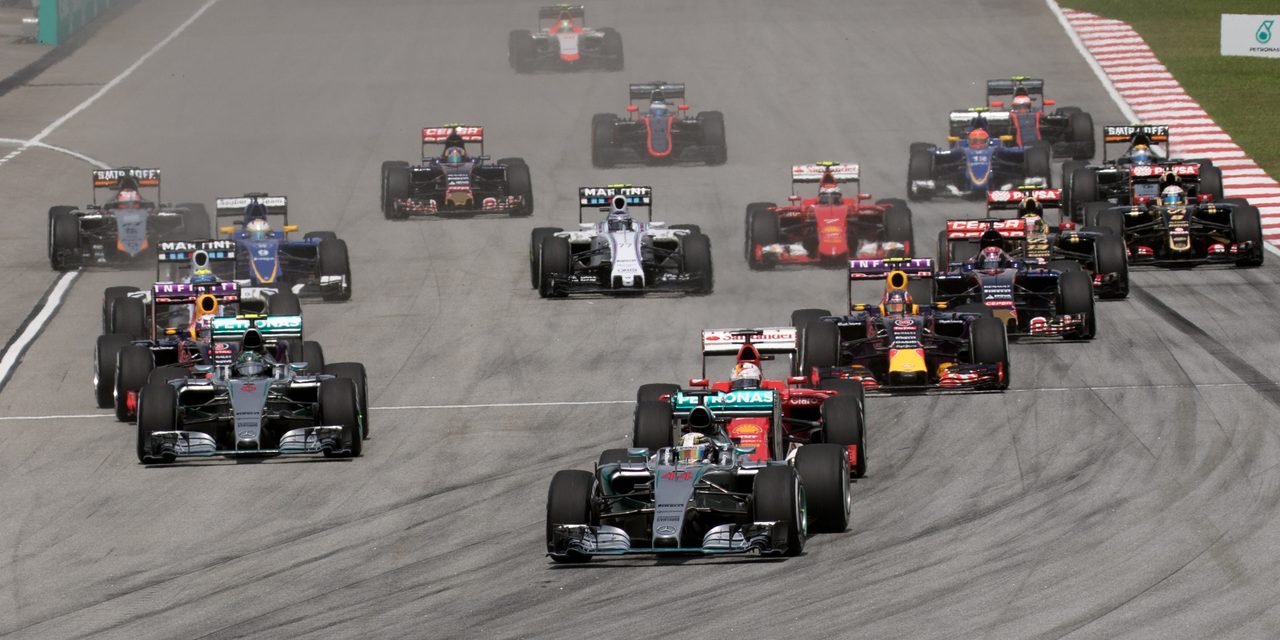
You're watching a Formula 1 race for the first time. Twenty cars line up on a grid, lights go out, and suddenly it's chaos — cars diving everywhere, commentators shouting about DRS and undercuts, tires that come in colors. Fun, but confusing.
This is your crash course. No engineering degree needed. By the end of it, you'll understand everything that happens between lights-out and the chequered flag.
The Weekend: How It All Unfolds
An F1 weekend is really three days:
- Friday — Practice: Three practice sessions where teams test setups, tires, and upgrades. Drivers learn the track; engineers collect data. Nothing counts yet.
- Saturday — Qualifying: This decides the starting order for Sunday. More on this below — it's a whole sport of its own.
- Sunday — The Race: The main event. A typical Grand Prix runs about 305 km (roughly 1.5 to 2 hours, depending on the track).
Some weekends throw in a bonus: the Sprint. That's a shorter Saturday race of about 100 km with its own mini points payout — 8 points for the winner, down to 1 for 8th place. It doesn't replace the main race; it's extra action.
Qualifying Explained: Saturday's High-Stakes Shootout
Qualifying decides who starts where on Sunday's grid, and it works like a knockout tournament against the clock. Three rounds, three cars' worth of heartbreak:
- Q1 — 18 minutes: All 20 drivers set lap times. The slowest 5 are eliminated. They start 16th through 20th on Sunday.
- Q2 — 15 minutes: The remaining 15 drivers go again. The slowest 5 drop out. They start 11th through 15th.
- Q3 — 12 minutes: The last 10 standing fight it out. Fastest lap takes pole position — the very front of the grid, the best seat in the house.
Starting position matters enormously. Passing is hard in F1, so the front rows are prime real estate. And there's a backstop rule: the 107% rule. To be allowed to race, a driver must set a lap within 107% of the fastest Q1 time. It's rarely triggered, but it exists to keep dangerously slow cars off the grid.
Think of qualifying as three rounds of musical chairs, except the chairs are grid slots and the music is the clock running down.
Lights Out: The Start and the First Lap
The start is the most chaotic — and often most decisive — part of a race. Cars launch from a standing start, and the sprint to the first corner is pure adrenaline. Drivers who make up positions here can have their whole race transformed; those who botch it spend an hour trying to recover.
The first lap is always frantic. Twenty cars funnel into corners built for one racing line. Small touches between cars happen — sometimes it ends there, sometimes it triggers a safety car (we'll get to that). Watch the first two minutes closely; you'll often see the seeds of the final result.
One thing to know: overtaking is tightly regulated at the start. DRS is banned for the first two laps after the start and after every restart, so drivers have to pass the old-fashioned way — by out-braking and out-driving each other.
DRS: The Overtake Button
DRS stands for Drag Reduction System. It's a flap on the rear wing that opens to cut air resistance, giving the car a speed boost of roughly 10–15 km/h on straights. It's F1's built-in overtaking aid.
But it comes with strict rules:
- It can only be used in marked DRS zones — specific straights the track designates in advance.
- A driver may only use it when within 1 second of the car ahead at a detection point just before the zone.
- It stays closed on the first two laps, after restarts, and in wet conditions.
The result: a faster car stuck behind a slower one gets a genuine shot at passing, which keeps races from turning into parades. When you see a driver sweep past on a straight and the commentator says "DRS wide open," that's what they're talking about.
Pit Stops and Tires: The Chess Game
Here's where F1 gets strategic. The tires are color-coded so you can read the race like a scoreboard:
- Soft (red): Fastest, but wears out quickly.
- Medium (yellow): The balanced middle ground.
- Hard (white): Slowest at first, but lasts the longest.
- Intermediate (green) and full wet (blue): For rainy conditions.
The key rule: in a dry race, every driver must use at least two different compounds. That forces at least one pit stop per car — nobody can just cruise to the finish on one set of tires.
And pit stops are absurdly fast. The top crews change four tires in about 2–2.5 seconds. A slow stop (anything over 3 seconds) is a genuine disaster that can cost a driver several positions.
Strategy is where races are won and lost. Pit early and you get fresh tires but must make them last (undercut — diving in before your rival to gain track position when they stop later). Stay out long and you keep track position but slide around on worn rubber. Teams pick their moments based on tire wear, traffic, and timing gaps — and when they get it right, it's beautiful.
Flags and the Safety Car
When things go wrong, the marshals communicate with flags. Learn these four and you'll never be lost:
- Yellow: Danger on track — slow down, and no overtaking in that sector.
- Red: The session is stopped. Something serious has happened; cars return to the pits.
- Blue: Move over — a faster car is about to lap you. (Backmarkers must let leaders through.)
- Chequered: The finish. Wave it and the race is over.
The safety car is the great race-shuffler. When there's a crash or debris on track, the safety car comes out and the whole field bunches up behind it at reduced speed. Gaps built over dozens of laps vanish instantly — and pit stops under a safety car cost much less time than normal. That's why you see teams rush in for "cheap" stops the moment one appears. It can flip a race upside down.
Scoring Across a Season: Two Championships at Once
F1 runs two championships in parallel over a season of roughly two dozen races:
- Drivers' Championship: each driver collects points individually. The highest total wins the world title.
- Constructors' Championship: each team (two drivers per team) pools both drivers' points. This decides the teams' title — and a huge share of prize money.
Points go to the top 10 finishers on this scale:
25 – 18 – 15 – 12 – 10 – 8 – 6 – 4 – 2 – 1
That's why consistency matters as much as wins. A driver who finishes 2nd every week (18 points each time) will outscore a rival who alternates between 1st and crashing out. Teams play both games at once: one driver's championship charge, plus the combined tally that pays the bills.
Your First-Race Checklist: What to Watch for This Sunday
Keep this list beside you during the race and you'll follow the story like a veteran:
- Watch the start. Who gained positions into the first corner? That's the tone-setter for the whole race.
- Note who starts on which tire. Softs = aggressive early; mediums = playing the long game.
- Listen for pit stop windows. Commentators will say a driver is "pitting in the next few laps" — watch whether rivals cover the stop or stay out.
- Count the DRS passes. When a driver closes to within a second at a detection point, a pass on the next straight is likely.
- Watch for flags. A yellow means someone's in trouble; a safety car means everything you know about the running order might change in two laps.
- Track the points battle. Even midfield drivers fighting for 8th are racing for real points that decide championships.
- Don't switch off early. Races are regularly decided in the final ten laps — fading tires, late safety cars, and bold strategy calls all live there.
That's the whole game. Enjoy your first race — you'll be arguing about undercuts and tire strategy before you know it.